What "occasional diarrhea" usually means in cats
Cats are sensitive to small changes. A new food brand, a litter change, stress from house guests, a vet visit, or just an off day can produce a couple of days of loose stool. Most of these episodes resolve on their own within 2-4 days.
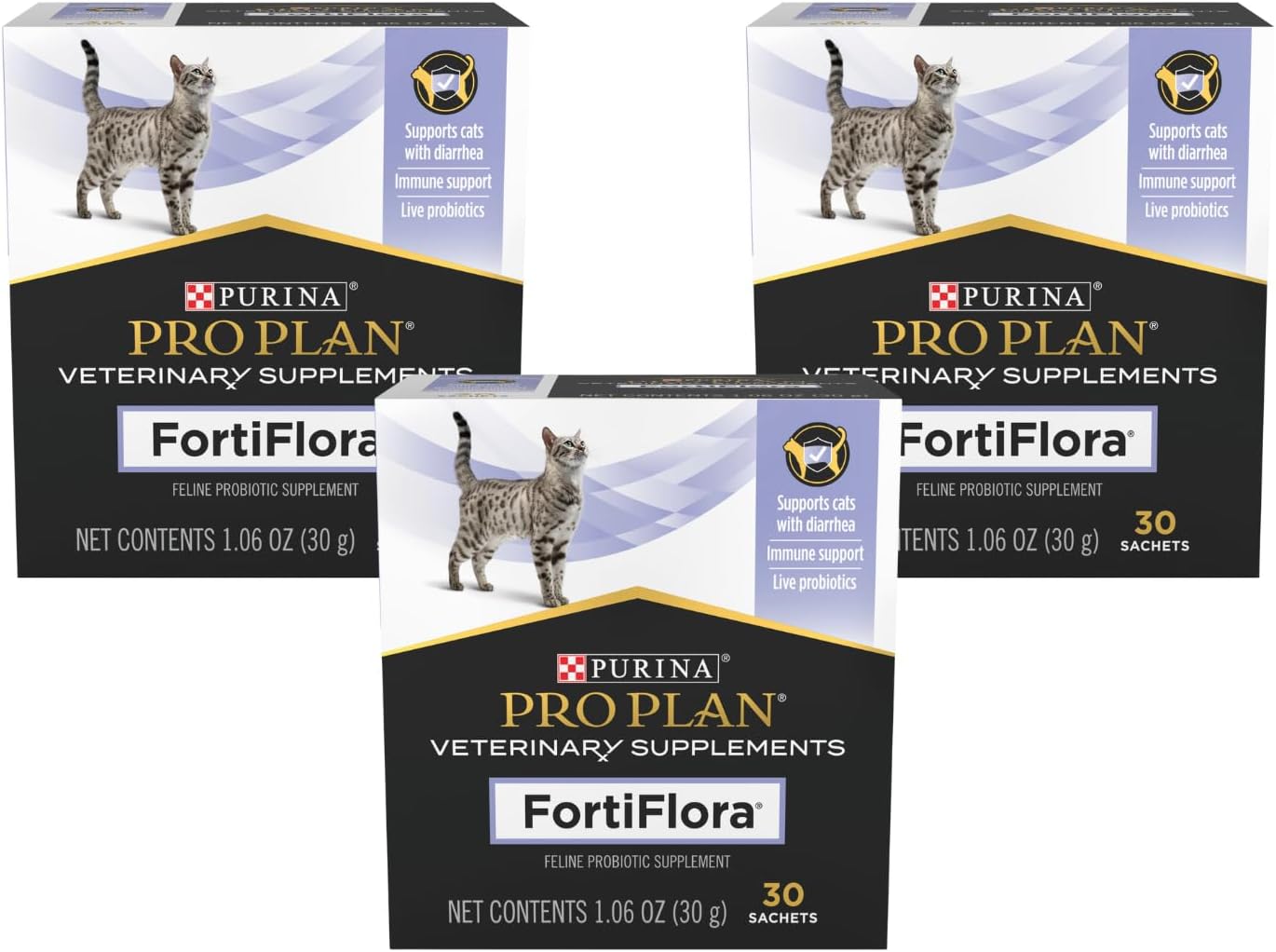
When the same cat has occasional episodes — meaning a few times a year, each lasting a few days, with normal stool in between — probiotic support is one of the simplest interventions. FortiFlora Feline (the cat-specific formulation) is the standard choice.
Why the cat formulation matters
FortiFlora makes two distinct products:
FortiFlora Feline — formulated for cats with cat-appropriate palatants. FortiFlora Canine — formulated for dogs.
The active probiotic strain (E. faecium SF68) is the same. The flavoring is different. Cats are particularly picky about flavors, and most cats reject the canine version even if you can get them to taste it.
For cats: always buy FortiFlora Feline. The packaging is clearly labeled.
Typical timeline for occasional diarrhea episodes
For uncomplicated stress or diet-related diarrhea in cats:
- Hour 0: Start one packet mixed into food
- Day 1: Same dose. May see slight improvement.
- Day 2: Visible improvement in stool consistency
- Day 3: Often back to normal
- Day 4-5: Continue for full benefit
- Day 5-7: Stop
Most cat owners see clear improvement within 48 hours of starting. Faster than for many dog scenarios, partly because the typical cat diarrhea episode is mild and self-limiting anyway.
When occasional becomes frequent
A few signs that "occasional" has shifted to "chronic":
- Diarrhea episodes happening every 4-6 weeks regularly
- Episodes lasting longer than they used to (5-7 days instead of 2-3)
- More severe symptoms during each episode
- Stool not fully returning to normal between episodes
- Weight loss or appetite changes alongside the pattern
When this happens, the supplement-only approach isn't enough. Time for a vet visit to investigate underlying causes — food sensitivity, inflammatory bowel disease, parasites, hyperthyroidism, kidney issues, or other causes that mimic occasional GI upset.
Mixing into food
Cats are notoriously picky about food additions. A few tips:
Mix into wet food, not dry. Wet food's strong aroma masks the supplement. Dry kibble with powder sprinkled on it often gets ignored.
Stir thoroughly. Don't sprinkle on top — fully mix it in.
Use a small portion. Mix into half the cat's normal meal rather than the entire bowl. If the cat refuses the FortiFlora portion, you have a clean second half to offer.
Try a topper. Plain unsweetened yogurt, a spoonful of low-sodium tuna water, or a small amount of meat baby food can be combined with FortiFlora for picky eaters.
Pill-pocket-style approach. Some cats accept a small ball of wet food with FortiFlora mixed in as a treat-like item.
If your cat absolutely refuses food with FortiFlora, the supplement isn't going to be the right fit. Cats won't eat what they don't want, and forcing the issue creates more stress.
Stress-related diarrhea in cats specifically
Cat stress diarrhea is common and FortiFlora addresses it well. Typical triggers:
House moves. First few days in a new home. Pre-load FortiFlora for 2-3 days before the move if possible.
New pets. Cats adjusting to a new dog or cat in the household often have GI sensitivity for 2-3 weeks.
Guests staying. Disruption of normal routine produces stress diarrhea in sensitive cats.
Litter box changes. New litter brand, new box, new location.
Veterinary visits. Some cats have post-vet diarrhea for 1-2 days.
Boarding. Variable — some cats handle boarding fine, others come home with several days of GI upset.
For predictable stress events, pre-loading FortiFlora for 2-3 days before plus 5-7 days after often prevents the diarrhea entirely.
Diet-change diarrhea
When you have to switch cat food (brand discontinuation, dietary changes, vet recommendation):
Plan the transition. Mix the foods over 7-10 days, gradually shifting from old to new.
Start FortiFlora 2-3 days before the transition begins. Continue through the full switch plus 5-7 days after.
Watch for response. Most cats handle gradual transitions with FortiFlora support without significant symptoms.
If symptoms appear, slow down. Go back to a more favorable mix ratio and stay there longer.
What FortiFlora won't help with in cats
A few cat GI patterns that aren't probiotic-responsive:
Hairball-related issues. Vomiting and occasional stool changes from hairballs need hairball-specific products, not probiotics.
Parasite-related diarrhea. Needs vet diagnosis and specific treatment.
Chronic vomiting without diarrhea. Suggests upper GI issues, possibly IBD or pancreatitis. Vet visit.
Bloody stool. Always a vet call. Multiple possible causes, none of which a probiotic addresses.
Diarrhea with severe lethargy or refusal to eat. Beyond probiotic scope.
Multi-cat household considerations
If you have multiple cats, a few specific points:
One cat with diarrhea doesn't mean all need supplementation. Treat the affected cat; leave others on normal routine unless they develop symptoms.
Watch all cats for shared cause. If multiple cats develop diarrhea simultaneously, the cause is probably shared — food, stress event, or possibly infection. Vet visit warranted.
Stress in one cat can affect others. Behavioral chains in cat households are real. A new cat's stress sometimes triggers GI symptoms in existing cats.
Buy in bulk if multiple cats need FortiFlora. 3-pack pricing is more economical for multi-cat use.
How long to keep on hand
A 30-packet box has a shelf life of about 18 months. For households with occasional cat diarrhea episodes, one box per year is usually enough — using 5-10 packets per episode, 2-4 episodes per year for a sensitive cat.
For more frequent use or multi-cat households, plan on 1-3 boxes per year.
Bottom line
FortiFlora Feline is well-suited for occasional cat diarrhea episodes. Works within 24-48 hours for most cases. Use the cat version, not the dog one. For frequent or worsening patterns, the supplement isn't a substitute for vet investigation.
When to call your vet
- Diarrhea lasting more than 3-4 days despite supplement support
- Frequent diarrhea episodes (every 4-6 weeks or more)
- Diarrhea plus vomiting, lethargy, or appetite loss
- Blood or mucus in stool
- Weight loss alongside GI symptoms
- Multiple cats with simultaneous diarrhea
- Senior cat with new-onset GI changes
- Any concerns about dehydration — cats dehydrate dangerously fast